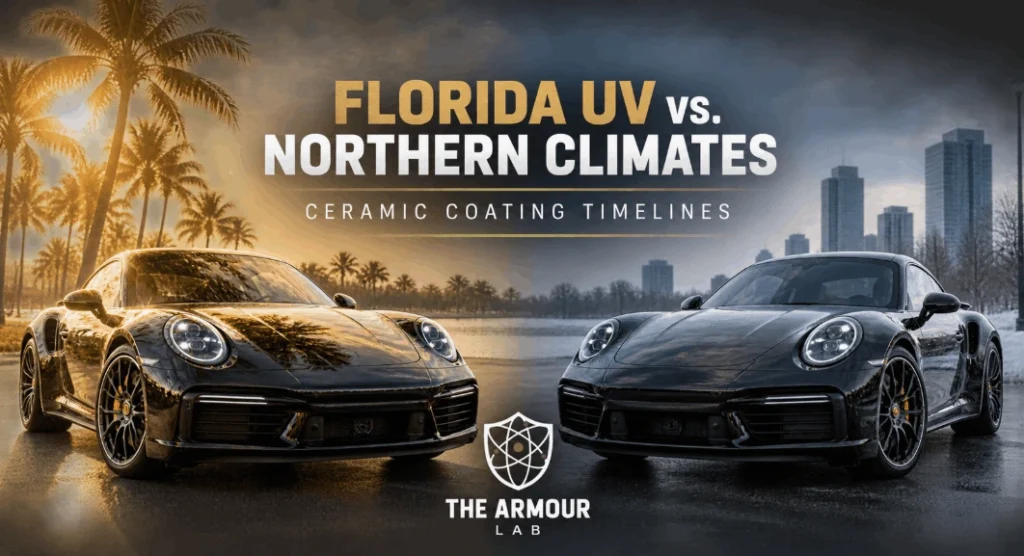


Two cars get the same ceramic coating on the same day. One lives in West Palm Beach, Florida. The other lives in Vaughan, Ontario. Five years later, the two coatings look very different.
Why? The sun. Most guides give one timeline for every car. That advice ignores where you park.
In this post, you will learn:
- How UV rays wear down ceramic coating
- How West Palm Beach and Vaughan compare
- How often each market should reapply
- How to make your coating last longer
How UV Exposure Breaks Down Ceramic Coating Over Time
The chemistry behind UV degradation of coating layers
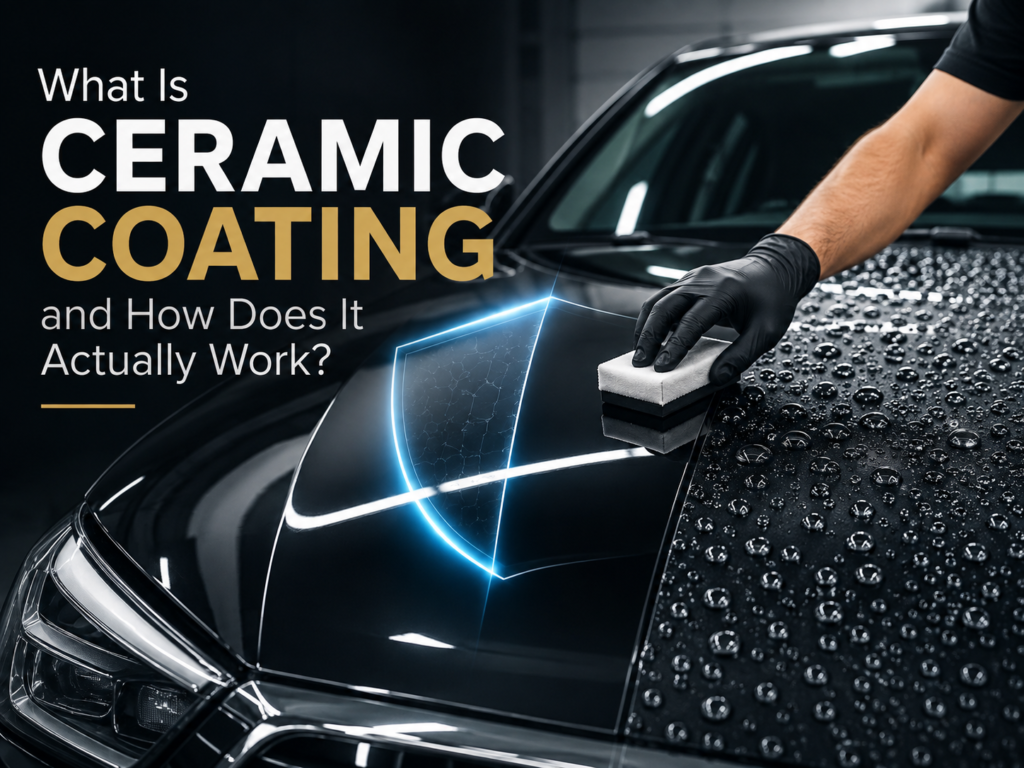
A ceramic coating is a thin, hard layer on your paint. It contains silica (SiO2) and other ingredients that make it slick and water-repellent.
UV rays carry energy. Over time, that energy breaks weak chemical bonds in the coating. Here is what happens in steps:
- UV rays hit the coating every day.
- The rays break down the parts that repel water.
- Water stops beading as well.
- Dirt sticks more easily.
- The coating loses gloss and protection.
Heat makes this worse. A dark car in a hot parking lot can get very hot. Heat speeds up the wear.
Good coatings fight UV better. But no coating lasts forever.
Why year-round sun exposure differs from seasonal exposure
Think of it like a hiker’s boots. A hiker who walks 12 months a year wears out boots faster than one who walks 6 months.
Seasonal sun gives a coating a break. Year-round sun gives it none.
- Seasonal sun: The coating rests in winter.
- Year-round sun: The coating works hard every single day.
That is the key difference between Florida and Ontario.
Comparing West Palm Beach and Vaughan Climate Conditions
Average UV index and sun exposure hours in each region
Here is a simple, general comparison. Exact numbers change by year and by day.
Factor | West Palm Beach, FL | Vaughan, ON |
Summer UV index | Very high to extreme (about 10 to 11) | High (about 7 to 8) |
Winter UV index | Moderate (about 4 to 5) | Low (about 1 to 2) |
Sunny hours per year | Roughly 2,800 to 3,000 | Roughly 2,000 to 2,200 |
Days with strong UV | Most of the year | About half the year |
In West Palm Beach, you feel the sun on a drive along Flagler Drive or a walk on Clematis Street. Cars parked outside near Currie Park or the Norton Museum of Art get hit all day. Even a winter day in Palm Beach County has real UV.
How seasonal snow cover in Vaughan reduces annual UV exposure
Vaughan has a real winter. From December to March, days are short. The sun sits low in the sky. Clouds cover it often.
That means far less UV reaches the car. Many owners in Woodbridge, Maple, and Kleinburg also park in garages during the coldest months.
Snow can bounce some UV back. But the low winter UV level starts so small that the total stays lower than in Florida.
Vaughan cars face another enemy in winter: road salt. Salt on Highway 400 and Highway 407 can harm paint and coating. That is a different problem than sun, but it matters for care.
What This Means for Reapplication Timelines in Each Market
Every coating and every car is different. Use these as general guides. Your installer should give you a plan based on your product.
Recommended reapplication intervals for Florida vehicles
Florida cars take more UV each year. So plan for more care.
- Full reapplication: Many owners look at every 2 to 4 years, based on the product and parking habits.
- Maintenance top-coat: Every 6 to 12 months.
- Inspection: Every 6 months. Check water beading and gloss.
Signs your coating needs help:
- Water no longer beads
- Paint looks dull
- Dirt sticks fast
- The car feels rough after washing
If you park outside near the beach or at work under open sky, plan on the shorter end. A garage helps a lot.
Want a plan built for the local sun? See our ceramic coating service built for South Florida sun.
Recommended reapplication intervals for Ontario vehicles
Vaughan cars get a UV break each winter. So a coating can often last longer on the sun side.
- Full reapplication: Many owners look at every 3 to 5 years, based on the product and care.
- Maintenance top-coat: Every 12 months, often in spring after salt season.
- Inspection: Twice a year. Check once in spring and once in fall.
Vaughan owners should watch for salt damage, not just sun. Wash often in winter. Rinse the underside and lower panels well.
Not sure what fits Ontario roads and weather? Look at our ceramic coating plans for Ontario winters in Vaughan.
Maintenance Tips to Extend Coating Life in High-UV Climates
Washing and maintenance routines suited to Florida sun exposure
Small habits add up. Try these:
- Wash every 1 to 2 weeks. Bird droppings, bugs, and salt air are harsh in the sun.
- Use a pH-neutral car soap. Harsh soap wears the coating.
- Wash in the shade. Hot paint makes soap dry too fast and leave spots.
- Dry with a clean microfiber towel. This stops water spots.
- Park in shade or a garage. This may be the best tip of all.
- Rinse off salt air residue. Do this often if you drive near the ocean.
- Skip cheap wax and harsh polishes. They can cover or scratch the coating.
Add a sunshade inside the car too. It protects your dash and seats.
When a maintenance top-coat makes sense between full reapplications
A maintenance top-coat is a light layer on top of your coating. It refreshes the slick feel and adds UV protection.
A top-coat makes sense when:
- Water beads less than before
- The gloss looks flat
- Your car sits outside most days
- You want to push a full reapplication further out
It costs less than a full new coating. In a place like West Palm Beach, it can save you money over time.
A pro can also check the coating first. That way, you fix only what needs fixing.
Conclusion
Here is the main point: the sun sets the clock.
- West Palm Beach has strong UV all year. Plan for earlier care.
- Vaughan gets a winter break from UV. But watch out for salt.
- A maintenance top-coat helps in both places.
- Good washing habits protect your coating anywhere.
Book a visit and get a plan that fits your car and your climate.
FAQs
Generally, yes. West Palm Beach has higher UV and more sun hours all year. Vaughan has a winter that cuts UV a lot. The coating in Florida takes more hits each year.
UV is strong and near constant there. Many Florida vehicles do best with more frequent maintenance and earlier reapplication than the same coating in a northern climate. Ask your installer to check your coating each year.
Yes. A maintenance treatment adds UV protection between full reapplications. It helps most in sunny places like South Florida.
Yes. Higher-grade coatings with stronger UV-resistant formulas tend to last longer in strong sun. That matters a lot in South Florida.