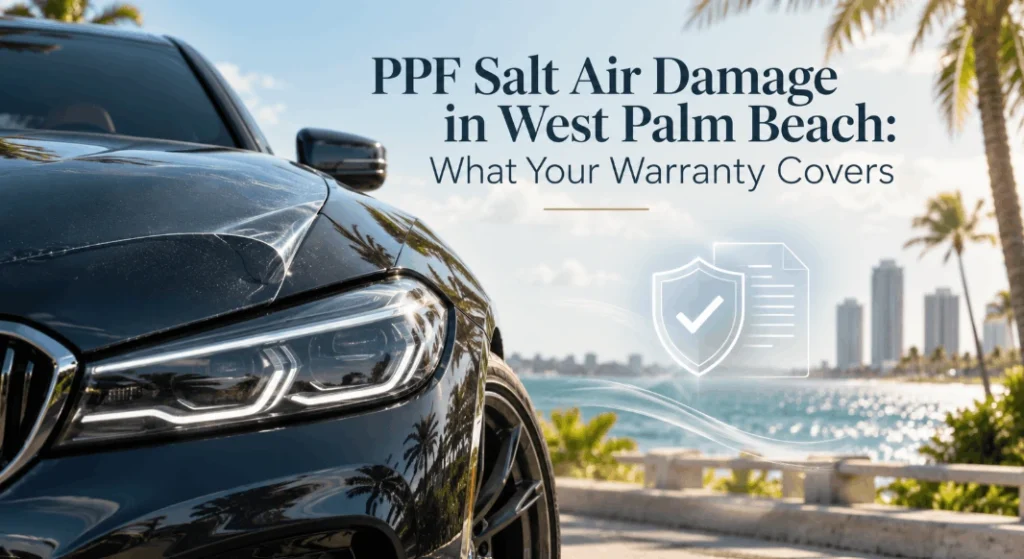


You drive along Flagler Drive with the Intracoastal Waterway on your side. The view is great. The air is salty. That salt lands on your car every day.
Most people buy self-healing PPF to stop scratches. That is a smart move. But many owners think the film also stops salt damage. It does not. Most warranties also skip this topic.
Few shops talk about this. This guide fills that gap. You will learn:
- How self-healing film works
- Why salt air is hard on cars near the coast
- What warranties often leave out
- How to keep your film in good shape
How Self-Healing PPF Technology Works
The science behind self-healing urethane film
Self-healing PPF has a clear top layer. This layer is soft and stretchy at a tiny level. Think of it like a firm gel.
When a light scratch cuts the top layer, the film moves. Heat makes the film flow back into place. The heat can come from:
- Warm sun on the hood
- Warm water from a hose
- A heat gun used by a pro
The scratch fades. The surface looks smooth again. In Florida, the sun does much of this work for free.
What types of damage self-healing film can and can’t repair
Self-healing film works best on light marks. It can fix:
- Swirl marks from washing
- Fine scratches from keys or bags
- Light marks from zippers or rings
It cannot fix:
- Deep cuts that go through the film
- Rock chips that punch a hole
- Gouges and tears
- Edges that lift or peel
- Stains from salt, bugs, or tree sap left too long
The last two points matter most here. Self-healing fixes scratches. It does not fix a lifted edge.
Why Coastal Salt Air Poses a Unique Challenge
How airborne salt particles affect film and underlying paint
Salt travels in the air near the ocean. Wind and waves lift tiny salt bits. Those bits settle on your car.
Salt also holds water. It pulls moisture from the air. So a salty car stays damp longer, even on a dry day.
Here is what that means for your car:
- Salt and moisture collect at film edges.
- Small gaps let salty water creep in.
- Dirt builds up along the edge and shows as a dark line.
- Bare metal in door jambs, under the hood, and under the car can rust faster.
PPF covers the paint it touches. It does not cover every part of your car. Salt still attacks the parts with no film.
Why coastal vehicles face different wear patterns than inland vehicles
A car in Wellington sees less salt than a car near the beach. A car that sits on Palm Beach Island or Singer Island sees a lot more. Even a daily drive over the Royal Park Bridge adds salt to your car.
Coastal cars often show:
- More dirt lines at panel edges
- Dull spots where salt dried on the film
- Faster wear near wheel wells, bumpers, and mirrors
- More rust risk on parts with no film
Inland cars see more road grime. Coastal cars see a steady salt coat. The wear looks different, so the care should look different too.
What Standard PPF Warranties Typically Exclude
Warranty terms differ by brand and by shop. Always read your own paperwork. The points below show what many warranties say.
Common exclusions related to environmental and corrosion damage
Most film makers cover product flaws. Common covered items include:
- Yellowing
- Cracking
- Bubbling from a film defect
- Peeling from a film defect
Many warranties leave out damage from the environment or from care habits. Common exclusions include:
- Salt and corrosion damage
- Stains from bird droppings, bugs, or tree sap
- Damage from harsh cleaners
- Damage from pressure washing too close to edges
- Rock chips and road debris
- Rust on parts with no film
Some warranties also ask you to follow a care plan. If you skip washes, the maker may deny a claim.
Why salt-related edge lifting isn’t always covered
Edge lifting can have many causes. A weak film is one cause. Salt, dirt, and moisture are others. A maker cannot always prove which one caused the lift.
Because of this, many warranties treat salt lifting as outside damage. The maker may say the film was fine and the environment caused the problem.
Ask your installer these questions before you buy:
- Does the warranty cover edge lifting? Under what terms?
- Does salt or coastal use change the coverage?
- Does the warranty cover labor, or only the film?
- Do I need to keep wash records?
- Who handles the claim, the shop or the film maker?
Get the answers in writing. This step protects you later.
How to Protect Your Investment in a Coastal Environment
Good care costs little. It can save you a lot.
Recommended washing frequency for salt-exposed vehicles
More salt means more washing. Here is a simple guide:
- Near the beach or Palm Beach Island: Wash every 1 to 2 weeks.
- Farther inland, with some coastal driving: Wash every 2 to 3 weeks.
- After a beach trip or a windy, stormy day: Rinse within a day or two.
Follow these tips:
- Use a pH-neutral car soap.
- Use a soft wash mitt.
- Rinse well around edges, mirrors, and door jambs.
- Keep a pressure washer nozzle at a safe distance from edges.
- Dry the car with a clean microfiber towel.
- Do not let salt dry on the film.
Ask your installer for their care guide. Follow it for your specific film.
Inspection routines to catch edge lifting or damage early
Take five minutes each month. Walk around your car in good light. Check these spots:
- Hood and fender edges
- Around the headlights
- Mirror caps
- Bumper corners
- Door edges and door handles
- Rocker panels
Look for:
- Corners that lift or curl
- Dirt lines along edges
- Small bubbles or dull patches
- White or hazy spots
- Rust on nearby bare metal
If you see lifting, do not pick at it. Do not press it down with your nails. Call your installer fast. A small lift is easy to fix. A big lift may need a new panel.
A few more habits help:
- Park in a garage when you can.
- Avoid parking under trees that drop sap.
- Rinse bird droppings right away.
- Keep records of your washes and visits.
Conclusion: Know the Limits, Then Protect Your Car
Self-healing PPF is a great tool. It fixes light scratches and keeps your paint looking sharp. But it does not stop salt air damage. Most warranties also leave salt problems out.
The fix is simple. Ask hard questions before you buy. Wash often. Check your edges each month. These habits keep your film clean and your warranty safe.
Want a film installed by a team that knows the coast? Learn more about paint protection film in West Palm Beach from The Armour Lab. We will explain your options and your warranty in plain words.
FAQs
Not directly. Self-healing film fixes minor scratches and swirls with heat. It does not stop salt damage at film edges or on exposed areas over time.
Usually not. Most warranties cover film defects like yellowing. Salt-related edge lifting is often excluded. Read your warranty terms closely.
Wash more often than an inland car. Removing salt early helps protect the film edges and the glue that holds them.
Yes. Steady salt exposure can slowly weaken the hold at film edges. Regular checks and washes help you catch problems early.