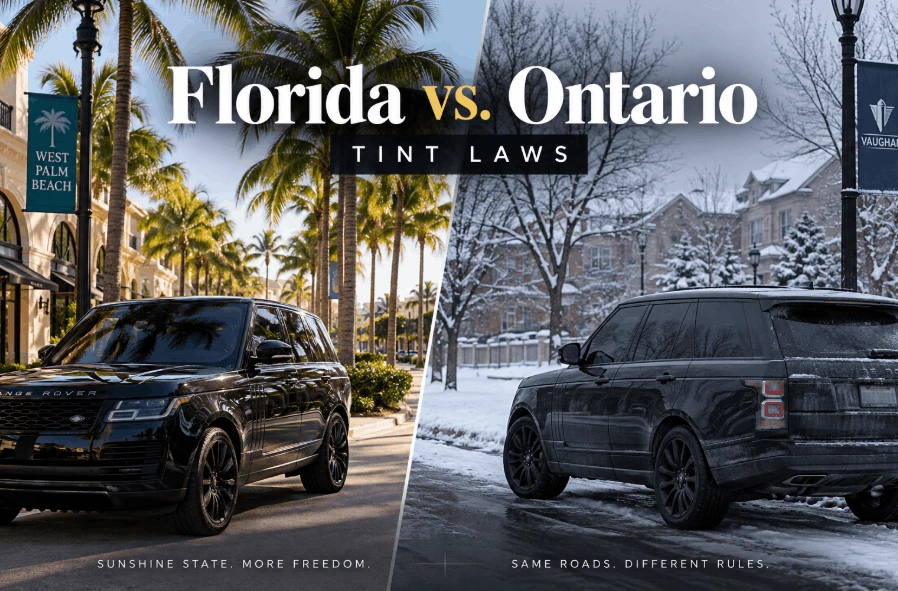


Florida lets you tint front side windows to 28% VLT, and the glass may reflect no more than 25% of light. Ontario’s law sets no fixed number. Police and inspectors expect front side windows at 70% VLT or lighter. Behind the driver, Florida allows 15% on sedans and 6% on SUVs, vans, and pickups. Ontario allows any darkness on rear side windows. Cross these lines and you risk a ticket, a fix order, or a failed safety inspection.
Tint also protects your skin. The Skin Cancer Foundation says UV window film blocks more than 99% of UVA and UVB light. One 2016 study found that windshields blocked 96% of UVA rays, but side windows blocked only 71%. The Foundation also shares the case of a truck driver who spent 28 years at the wheel. The skin on the left side of his face aged far more than the right. Legal tint gives you that protection without the legal risk.
Reading Tint Numbers Without the Guesswork
VLT means visible light transmission. It shows how much light passes through your glass. A lower number means darker tint.
Your factory glass counts too. Multiply the two numbers. A 50% film on 70% factory glass gives you about 35%. Florida tests the film on the glass of the specific vehicle, so the box rating alone does not prove you are legal.
Florida Window Tint Limits by Window
Window | Sedan or Coupe | SUV, Van, or Truck |
Windshield | Clear strip above the AS-1 line only | Same |
Front side windows | 28% VLT or lighter, 25% reflective at most | Same |
Rear side windows | 15% VLT or lighter, 35% reflective at most | 6% VLT or lighter, 35% reflective at most |
Rear window | 15% VLT or lighter | 6% VLT or lighter |
A non-see-through rear window also needs side mirrors on both sides.
Medical Exemptions in Florida
The state issues medical exemption certificates for lupus, autoimmune disease, and other conditions that need limited light exposure. Keep the certificate in your car.
Florida Penalties
A tint violation is a noncriminal traffic infraction, punished as a nonmoving violation. You pay a fine and may need to fix the tint.
Ontario Window Tint Limits by Window
Ontario works differently. The Highway Traffic Act does not name a tint percentage. Section 73(3) bans coloured or reflective coatings on the windshield and front side windows that substantially obscure the inside of the vehicle. In practice, the 70% VLT standard from the safety inspection guides what officers expect.
Window | Ontario Rule |
Windshield | No aftermarket film at all |
Front side windows | Aim for 70% VLT or lighter. Do not hide the interior. |
Rear side windows | Any darkness |
Rear window | Any darkness if both side mirrors work |
Since January 1, 2017, aftermarket windshield tint has been banned, even a thin strip at the top. Fines are commonly listed from $85 to $500 CAD, plus court surcharges.
Florida vs. Ontario Side by Side
Topic | Florida | Ontario |
Front side windows | 28% VLT minimum | No set number, 70% is the safe target |
Rear side windows | 15% sedan, 6% SUV | Any darkness |
Windshield | Strip above AS-1 line | No aftermarket film |
Type of penalty | Nonmoving violation | Fine, possible fix order |
What Happens If You Get It Wrong
Tickets and Fix Orders
An officer can stop you and write a ticket. You may also get an order to remove or fix the tint. Ignoring the order can raise your costs.
Failed Safety Inspections in Ontario
Ontario checks tint when you sell a used vehicle and need a safety standards certificate. Dark front tint can block that sale until you fix it.
Insurance and Accident Claims
A tint ticket alone does not make you at fault in a crash. But if dark tint blocked your view, a lawyer or insurer can raise it as evidence. Legal tint keeps that argument off the table. This is general information, not legal advice.
Driving Between Ontario and Florida
Many Ontario drivers head south each winter. Florida’s rules cover any vehicle on its public roads. Your Ontario tint may fail in Florida in one spot: the rear. A 5% rear tint is legal in Vaughan but too dark for Florida, even for an SUV.
The front is easier. Ontario’s 70% target is lighter than Florida’s 28% limit. If you pass Ontario’s standard, your front windows pass in Florida.
So if you split your year between Highway 400 and I-95, tint to the stricter rule for each window.
Stay Legal and Still Beat the Heat
You do not need dark film to block heat. Ceramic film rejects heat and UV rays while staying light enough to meet the law. Ask about ceramic window tinting in Vaughan, ON if you drive Vaughan Mills, Woodbridge, and Highway 407 every day.
In South Florida, the sun hits hard on Okeechobee Boulevard and along Flagler Drive by Clematis Street. See how window tinting West Palm Beach, FL can cool your cabin without a ticket.
Check Your Tint Before You Drive
- Ask your installer for the VLT reading on every window.
- Keep the receipt and film details in your glove box.
- Add a medical exemption certificate if you have one.
- Retest after you buy a used car, since old film may fail today’s rules.
Why Choose The Armour Lab
The Armour Lab is a window tinting shop with two homes. We serve drivers in Vaughan, Ontario and in West Palm Beach, Florida. Since we work under both sets of rules, we understand how the law changes at the border.
Our team installs ceramic window tint for cars, SUVs, and trucks. We help you pick a shade that fits your local law and your daily drive. We also explain every limit in plain words before we touch your glass.
If you split your year between Ontario and Florida, we can help you plan a tint that works in both places. Ready to tint the right way? Get a quote for window tinting in Vaughan or West Palm Beach today.
Conclusion
Florida and Ontario both care about visibility, but they measure it differently. Florida gives you exact percentages. Ontario gives you a visibility test and a 70% guide for the front. Know your numbers, measure the finished glass, and keep your paperwork. That is the easiest way to avoid a ticket.
FAQs
No, 5% is darker than every Florida limit unless you hold a medical exemption.
It sits below the 70% that inspectors and police expect, so you risk a ticket.
Yes, Florida measures your film and the factory glass together.
Yes, the state issues medical exemption certificates for conditions like lupus.
Often yes, because officers can order you to fix it.